

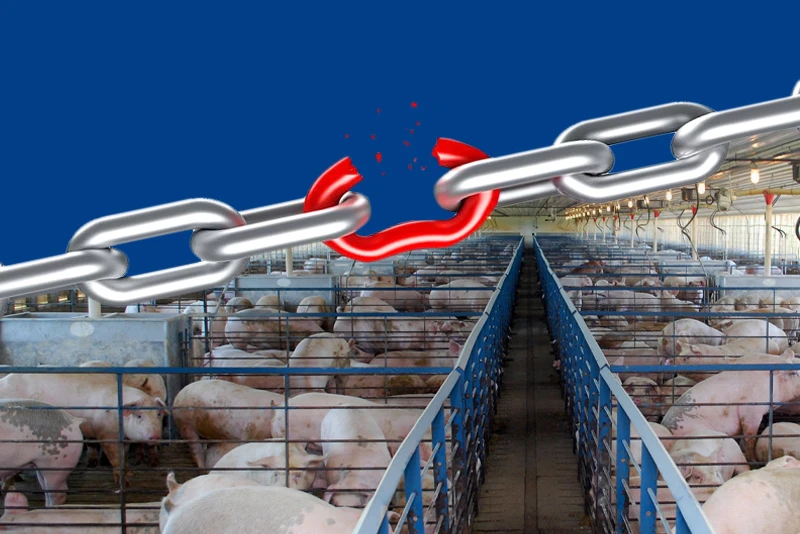
The U.S. swine industry relies on a multi-site system where pigs are moved between separate farms for different growth phases. Although efficient, this constant movement of pigs, people and equipment creates significant pathways for disease transmission.
“While sow farms often follow strict biosecurity protocols, there is limited information on how these practices are implemented and their impact on pathogen introduction in growing pig populations,” Mariah Negri Musskopf, DVM, said at the American Association of Swine Veterinarians Annual Meeting in Las Vegas.
Wean-to-finish sites play a critical role in disease dynamics but are less frequently studied. Musskopf and a team of researchers at Iowa State University set out to identify bioexclusion practices associated with porcine reproductive and respiratory syndrome virus (PRRSV) outbreaks in U.S. wean-to-finish sites.
A prospective observational study was conducted on 95 wean-to-harvest sites managed by eight companies across six states, including 33 nursery, 17 finisher and 45 wean-to-finish sites. All flows were either PRRSV-negative or PRRSV-positive stable vac¬cinated with modified-live vaccine at placement, Musskopf explains. Sites completed a detailed biosecurity survey covering 17 categories, including local swine site density. Oral fluid samples were col¬lected every four weeks from placement to market, refrigerated, and submitted to the Iowa State University Veterinary Diagnostic Laboratory for analysis.
The “Finisher” Problem
The results showed finisher sites were the most vulnerable, with an 82.4% outbreak rate, compared to wean-to-finish (66.7%) and nurseries (33.3%).
“These findings show that site type and farm density are key driv¬ers of PRRSV outbreaks, with finishers in dense areas at greatest risk,” says Musskopf, a graduate student at Iowa State University College of Veterinary Medicine.
Some of the top risk factors discovered include:
- Local Farm Density: For every additional swine farm within a one-mile radius, the odds of a PRRSV outbreak increase by 62%.
- Carcass Disposal: Using rendering services was associated with a 6.47 times higher odds of an outbreak.
- Human Connections: Employees who live with others who also work in the swine industry face a 6.15 times higher odds of bringing the virus to their site.
Proven Protective Measures
There’s power in downtime. Implementing overnight downtime for employees who work across multiple sites significantly associated with lesser outbreaks, providing a critical window to prevent cross-contamination.
The study suggests prioritizing biosecurity and surveillance on high-risk finisher sites is beneficial, especially those located in “swine-dense” geographic areas.
Controlling PRRSV requires looking beyond the sow farm, Musskopf says.
“Veterinarians and production systems can use this knowledge to improve surveillance and biosecurity on high-risk sites, review practices adopted during carcass disposal and employee downtime, and cohabitation,” Musskopf says. “Targeting these factors can reduce opportunities for virus introduction and improve regional PRRSV control.”


