

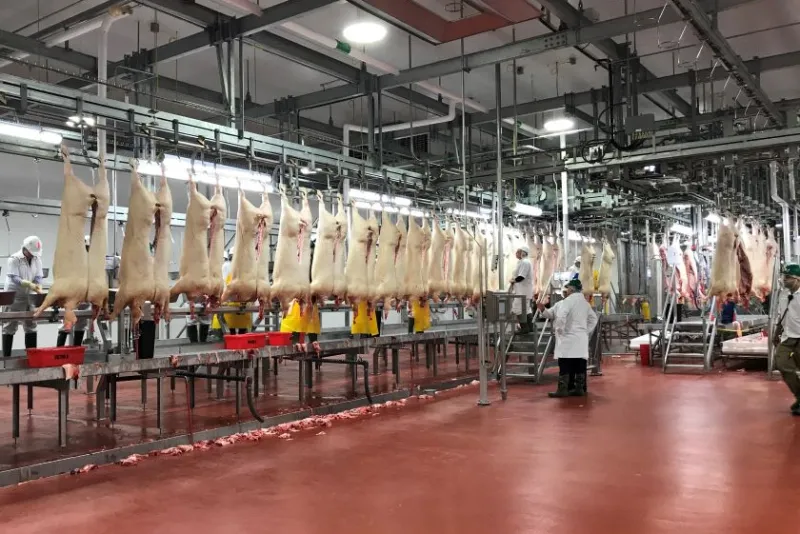
USDA’s Food Safety and Inspection Service (FSIS) is again extending the New Swine Inspection System (NSIS) line speed trials through Jan. 15, 2025. Processing facilities will enroll in a modified time-limited trial, which will include a study to evaluate the impact of increased line speeds on worker safety.
According to industry economists, without the increase in line speeds – and the resulting decrease in packing capacity – some pork producers could have incurred an additional loss of nearly $10 a head in the first and second quarters of 2024, the National Pork Producers Council (NPPC) noted in a release.
“We appreciate USDA and FSIS for listening to the pork industry and taking another step toward making permanent these increased line speeds, which totals more than three percent of national harvest capacity,” said NPPC President and Missouri pork producer Scott Hays. “These actions give pork producers more certainty in an uncertain time.”
In March 2021, the U.S. District Court for the District of Minnesota vacated the component of USDA’s New Swine Slaughter Inspection System (NSIS) that eliminated line speed limits for participating establishments. As a result, all NSIS establishments were required to operate at line speeds not exceeding 1,106 head per hour (hph) as of June 30, 2021. In November 2021, USDA’s Food Safety and Inspection Service (FSIS), in consultation with the Occupational Safety and Health Administration, invited NSIS establishments to participate in a time-limited trial (TLT), during which the establishments have been allowed to operate at an increased line speed while collecting and submitting data that would be used to evaluate the impact of increased line speed on workers.
FSIS contracted with a third-party team of worker safety experts to evaluate the data submitted by the swine establishments. Last fall, the team of experts determined that the data submitted was not sufficient to evaluate the impact of increased line speeds on worker safety in NSIS establishments. Given the results, in November 2023, FSIS granted a 90-day extension of the TLT to facilitate the design of a study that will generate the necessary data to evaluate the impact of increased line speeds on worker safety and inform the agency’s next steps.
During the 90-day period, USDA and the contractors held several meetings with the participating establishments and other relevant stakeholders to develop a study plan. After the results were collected, FSIS announced on Feb. 26 that a swine study was needed and again extended the trials.
USDA and FSIS said the study will include on-site visits, interviews with establishment workers and measurements and observations of plant operations at 1,106 hph and respective establishment’s higher line speed. The contractors plan to work with the establishments to coordinate on-site visits that accommodate for plant operations and schedules.
“Establishments must continue to satisfy the original criteria for the TLT and participate in all aspects of the study to remain eligible for a modified TLT. Participating establishments will also be required to submit a range of relevant data as part of the study,” USDA explained in a release. “Additionally, worker safety agreements with each establishment’s union or worker representative will continue to be an essential part of the TLT. Participating establishments will need to provide documentation, on a quarterly basis, signed by a facility manager and the union or worker representative that verifies compliance and continued implementation of the worker safety agreement.”
Read more:


