

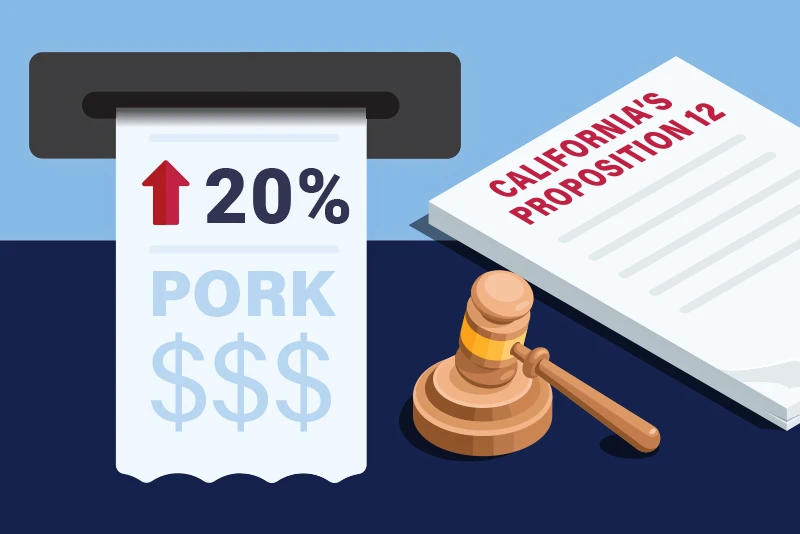
Two years after full implementation, California’s Proposition 12 continues to drive pork prices higher, according to new research from the North Dakota State University Agricultural Risk Policy Center.
The study reveals that prices for covered pork products have increased by an average of 20% compared to the rest of the country. As food affordability concerns grow, agricultural leaders are calling on Congress to address the “patchwork” of state regulations through federal legislation.
Data Shows Significant Price Hikes for Pork Cuts
The NDSU data highlights how Prop 12 has specifically impacted various pork products:
- Pork Loins: Up 32%
- Ribs: Up 22%
- Shoulders: Up 16%
- Bacon: Up 16%
In total, California consumers have paid an additional $350 million for pork products, leading to a significant decline in consumption across the state.
Relative to the pre-policy baseline, the retail price gap widened by 72.7 cents per pound in California and 62.8 cents per pound in Massachusetts, with a pooled increase of 71.2 cents per pound. These effects extend across major covered cuts, and California’s share of national pork purchases remains below its pre-policy level, declining from 8.5% to 7.1%, a relative reduction of approximately 16%.
“Overall, the evidence shows that Proposition 12 created a segmented market for compliant pork, sustained higher retail prices in compliant states, reduced relative purchases, and generated consumer costs that substantially exceeded the corresponding wholesale premium. The central implication is that the burden of compliance was shaped by supply chain transmission as much as by upstream production costs, with the largest effects emerging at the consumer end of the market,” the researchers summarize in the report.
NPPC Advocates for Legislative Relief on Capitol Hill
This week, 105 pork producers from 23 states met with federal lawmakers to advocate for their livelihoods. The National Pork Producers Council (NPPC) is pushing for the inclusion of language in the Farm, Food, and National Security Act (often referred to as Farm Bill 2.0) to prevent individual states from dictating farming practices beyond their borders.
“We need relief from a patchwork of state animal housing laws, which will surely be the nail in the coffin for a number of farms across the country,” says NPPC President Rob Brenneman, a producer from Washington, Iowa. “The mission is clear: We need Congress to exercise their authority and fix Prop 12.”
Veterinary Concerns and Economic Uncertainty
The impact of Prop 12 extends beyond the grocery aisle. The American Veterinary Medical Association (AVMA) has expressed frustration, stating that these regulations “do not objectively improve animal welfare and may unintentionally cause harm.”
As the industry faces ongoing uncertainty, the NPPC remains committed to ensuring producers can operate without the burden of conflicting out-of-state regulations.


