
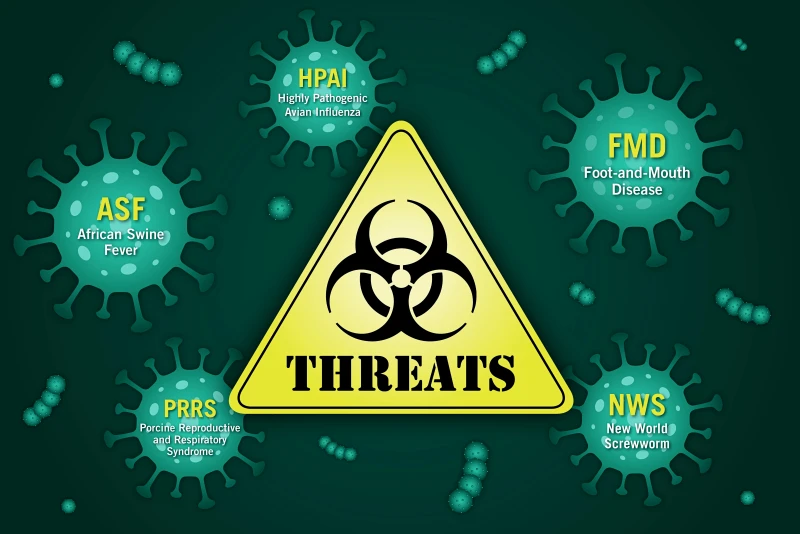
Production animal disease outbreaks are not only animal health events but threats to economic stability and food security. A new report from The Farm Journal Foundation, The Mean Sixteen: Biosecurity Threats Facing U.S. Agriculture, estimates the collective annual costs to U.S. agriculture due to outbreaks of the top five livestock diseases could top $300 billion without proper preparation.
“It is absolutely crucial that the U.S. should support mechanisms to protect farmers from risks and make sure that our food supply chain can remain resilient even when challenges occur,” wrote Stephanie Mercier, senior policy adviser at Farm Journal Foundation.
Mercier identifies five diseases with the potential to disrupt U.S. livestock production, trade and response infrastructure at scale. These include foreign animal diseases as well as ongoing threats:
- Foot-and-mouth disease (FMD)
- African swine fever (ASF)
- New World screwworm (NWS)
- Highly pathogenic avian influenza (HPAI)
- Porcine reproductive and respiratory syndrome (PRRS)
Foot-and-Mouth Disease: Trade-Stopping Risk to U.S. Livestock
Foot-and-mouth disease, an infectious and sometimes fatal viral disease affecting a range of ungulates, remains one of the highest-impact foreign animal disease threats to U.S. agriculture. While the U.S., Canada, and Mexico are classified as FMD-free, outbreaks in Taiwan (1997), the United Kingdom (2001), and this year in Germany and Hungary, represent how relevant this disease remains as both an animal health and economic threat.
Modern production systems characterized by high animal density and frequent interstate movement would complicate containment efforts in case of an outbreak. In 2015, a report from Kansas State University found an FMD outbreak beginning in a U.S. state with high populations of vulnerable livestock could cost nearly $200 billion to the U.S. economy if no emergency vaccine program was implemented.
A 2018 provision to the farm bill mandated the establishment of an animal vaccine bank; FMD was chosen as the first disease for vaccine stockpile. While FMD vaccines reduce an animal’s chance of being infected, they are generally not administerd in FMD-free regions as it is difficult to distinguish between vaccinated and FMD-infected animals in a clinical setting. Further, World Organization for Animal Health (WOAH) protocols allow for trade bans to be imposed on countries using these vaccines.
African Swine Fever: Persistent Threat to U.S. Pork Production
African swine fever has expanded globally over the past decade and remains one of the most significant threats to the U.S. swine industry causing hemorrhagic fever with high mortality rates. In 2018, a massive ASF outbreak in China resulted in the loss of half of the country’s swine herd, approximately 225 million animals, and cost the country’s economy around $111 billion. Since then, ASF cases have been reported in countries across much of Asia and Europe.

It has been estimated an ASF outbreak in the U.S. would cost the economy nearly $80 billion, due to loss of exports and reduced industry revenue, but could also affect the crop sector due to decreased feed demand. The extensive feral hog population across much of the country would further complicate containment efforts.
There is no globally available ASF vaccine; however, in May 2025, the WOAH adopted their first international standard for ASF vaccines. This was followed by the release of field evaluation and post-vaccination monitoring standards in July.
New World Screwworm: Reintroduction Risk and Surveillance Dependence
The NWS fly lays eggs in an animal’s skin, often at wound sites, and the hatched larvae burrow into the animal, consuming the flesh. Prior to 2025, NWS had been largely absent in the Western Hemisphere north of Panama; however, since the beginning of the year, outbreaks have been creeping northward, with most recent detection being just 120 miles south of the U.S.-Mexico border.
The USDA estimates that if NWS were to cross the border into Texas, it could cost the state’s economy at least $1.8 billion while putting the rest of the U.S. beef sector at risk. In an effort to tackle this threat, the USDA announced a five-pronged plan to combat the pest including sterile fly production, closing of the U.S.-Mexico border to cattle trade and increased communication with state animal health officials.
The same sterile male fly technique that eradicated the pest in the U.S in 1966 is being applied for the current outbreak, with sterile fly production facilities open in Tampico, Mexico and opening in Edinburg, Texas.
While no NWS cases have been detected in the U.S. yet, the fly is still having an impact on the economy. With the U.S.-Mexico border closed to cattle imports, the already reduced U.S. cattle herd could shrink even further. With strong demand supporting U.S. beef prices, Omaha Steaks CEO Nate Rempe predicts ground beef prices could reach $10 per pound by the third quarter of 2026.

Highly Pathogenic Avian Influenza: An Ongoing Multispecies Challenge
Highly pathogenic avian influenza remains an evolving threat to U.S. animal agriculture. Twice in the past decade, major outbreaks in the U.S. have devastated poultry operations with losses of over 50 million commercial birds from 2014 to 2015. The latest HPAI outbreak began in 2022 and has since been detected in flocks in all 50 states resulting in an estimated loss of 169 million birds as of April 2025.

HPAI is a zoonotic disease with reported infections in humans, hogs, cats and dogs. In March 2024, HPAI was detected in dairy herds in Texas and Kansas. Since then, HPAI outbreaks have been confirmed in over 300 dairy herds across the U.S. in 14 different states.
The 2014 to 2015 HPAI outbreak is estimated to have cost U.S. agriculture over $1 billion when accounting for losses to both the poultry and animal feed sectors, as well as losses in land value. Both this outbreak and the subsequent 2024-25 outbreak caused significant spikes in egg prices, with March 2025 prices rising to 350% of those of the previous year. U.S. milk prices have not yet been affected by the outbreak.

Porcine Reproductive and Respiratory Syndrome: Endemic Disease, National Cost
The infection of hogs by PRRS has had a significant impact on the U.S. pork industry. First detected in the U.S. in 1987, PRRS infection causes pregnancy loss in sows and respiratory problems in pigs of all ages leading to poor performance. Unlike other animal diseases, PRRS infection can go undetected until issues with pregnant sows occur.
Analysis from Iowa State University shows PRRS caused an estimated $1.2 billion per year in lost production in the U.S. swine industry from 2016 to 2020. This marks an 80% increase over numbers reported a decade earlier.
With no cure at present, disease impact is minimized through biosecurity practices, vaccinations and management of infection with antibiotics. In April 2025, FDA granted PIC approval for the gene edit used in its PRRS-resistant pig. This technology could have a large impact on animal welfare, production costs and pork prices if adopted, though any impact is likely many years out.
Policy and Preparedness Implications for U.S. Animal Health
Across these diseases, the report identifies recurring gaps in U.S. animal health preparedness that extend beyond individual pathogens and suggests some key policy and infrastructure needs to help mitigate these threat risks:
- Improved national biosecurity coordination including culling guidelines
- Training for veterinarians for outbreak identification and reporting
- Support for vaccine stockpiling programs and prioritized regulatory approvals for prevention and treatment products
- Increased research support for both international collaboration and domestic work on biological control techniques of pests and pathogens, and disease-resistant genetic traits
“Investing in agricultural research, development and the long-term viability of our food supply chain is critical for protecting our national security and economy, and we are hopeful that our nation’s leaders will rise to meet this challenge before it’s too late,” Mercier writes.
The Farm Journal Foundation is a farmer-centered, non-profit, nonpartisan organization, created by Farm Journal in 2010, working to advance agriculture innovation, food and nutrition security, conservation and rural economic development.


